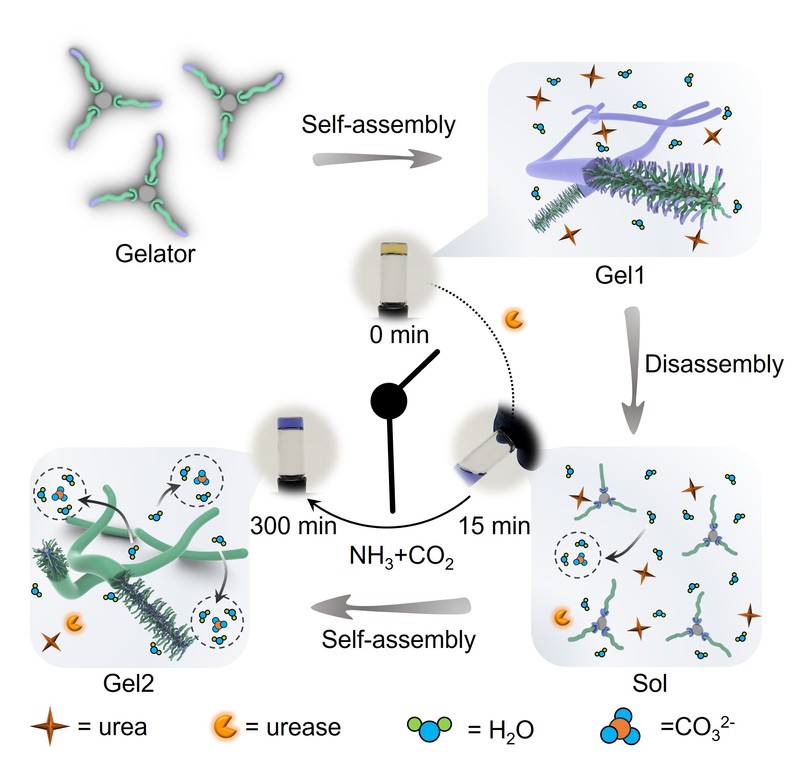
Shanghai, April 30, 2025 — Researchers at East China University of Science and Technology (ECUST) have created a smart supramolecular hydrogel that can dynamically sense and respond to specific ions, mimicking adaptive behaviors found in living systems. This work, which couples an enzymatic reaction with the classic Hofmeister effect, was reported in Angewandte Chemie International Edition and selected as a Hot Paper.
The key innovation lies in integrating the urea hydrolysis reaction with a gel-forming molecule containing carboxyl groups. As the enzyme urease breaks down urea, it generates kosmotropic ions (NH₄⁺, CO₃²⁻). These ions precisely regulate the self-assembly of the gel, driving an autonomous, reversible transformation from one gel state (Gel1) to a sol state and finally to a new gel (Gel2).
This research is the first to utilize the Hofmeister effect—which explains how specific ions influence molecular interactions—to create a self-regulating, intelligent supramolecular hydrogel. The material effectively converts a chemical signal (ion presence) into a macroscopic property change (mechanical state).
This breakthrough provides a new design strategy for developing life-like soft materials with potential applications in advanced biosensing and targeted drug delivery systems.