Shanghai, May 9, 2025 — A research team led by Professor Xuezhi Duan and Special Researcher Wenyao Chen from East China University of Science and Technology (ECUST) has unveiled a fundamental principle governing catalyst design. They discovered a bell-shaped dependence between metal particle size and the strength of the Strong Metal-Support Interaction (SMSI), a key phenomenon in catalysis. Based on this insight, they successfully designed a high-performance gold-zinc oxide (Au/ZnO) catalyst, significantly enhancing efficiency for oxidative coupling reactions. The findings are published in the Journal of the American Chemical Society.
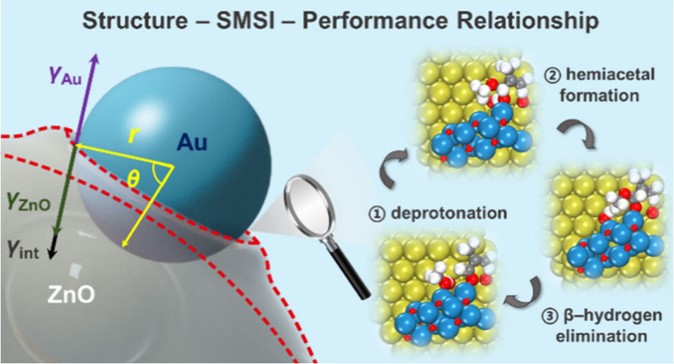
The study challenges the conventional view that strong SMSI only occurs with very small metal particles. The team found that slightly larger Au particles, when paired with nano-sized ZnO, create an optimal surface energy difference. This drives a partial encapsulation of the metal by the support, generating abundant oxygen vacancies and active Au–O species.
The researchers introduced the metal-to-support particle size ratio (rAu/rZnO) as a structural descriptor to predict SMSI strength. They demonstrated that catalytic performance peaks at an optimal ratio, balancing the activation of oxygen species and the exposure of active metal sites.
In the oxidative coupling of aldehydes and alcohols—a vital reaction for forming C-O bonds—the optimized Au/ZnO catalyst achieved an impressive 94.6% substrate conversion with 97.0% selectivity for ester products. The excellent performance stems from a synergistic mechanism: frustrated Lewis pairs at the interface facilitate condensation, while Au–O species accelerate the rate-determining β-H elimination step.
This bell-shaped rule proved universal, successfully guiding the design of other high-performance catalysts like Ir/ZnO and Rh/ZnO, and working across various substrate types.