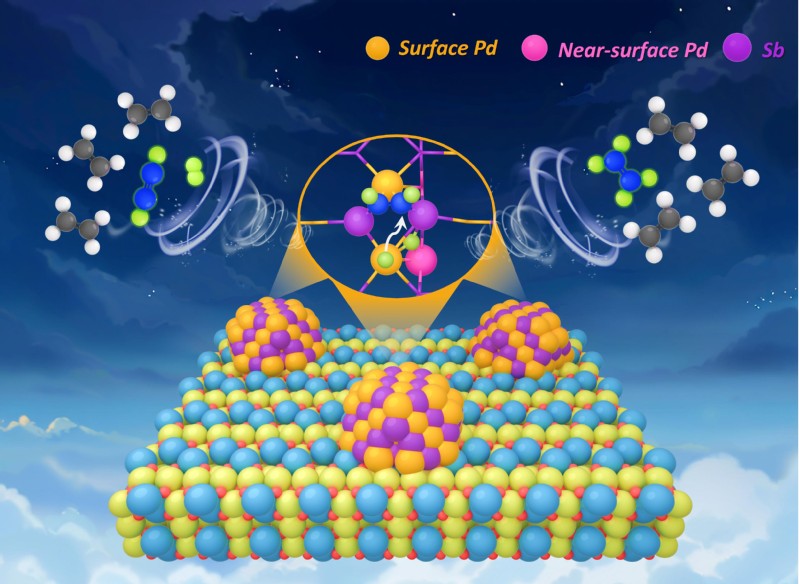
Shanghai, August 7, 2025 — Researchers from East China University of Science and Technology (ECUST) have developed a novel catalyst that overcomes a long-standing challenge in producing high-purity olefins. Their work on a palladium-antimony (PdSb) intermetallic compound achieves both high activity and exceptional selectivity in the semi-hydrogenation of alkynes, a critical industrial process. The findings were published in the Journal of the American Chemical Society.
Selective hydrogenation of low-carbon alkynes is essential for producing polymer-grade ethylene and propylene. Traditional palladium-based catalysts often suffer from over-hydrogenation and side reactions, creating a trade-off between achieving full conversion and maintaining high selectivity for the desired olefin product.
To solve this, the team designed a PdSb intermetallic catalyst featuring a unique synergistic structure. It combines surface Pd1Sb2 triatomic sites, which optimally adsorb the alkyne and olefin molecules, with neighboring sub-surface palladium (Pd) sites that efficiently activate hydrogen molecules. This spatial decoupling of reactant activation prevents competition and significantly enhances performance.
Under simulated industrial conditions, the new catalyst achieved 100% conversion for both acetylene and propyne. Remarkably, it also delivered record-high selectivity of 96.50% for ethylene and 98.65% for propylene, substantially outperforming all reported Pd-based catalysts and demonstrating a successful breakthrough in catalyst design.